Generic Pattern
Click any control badge to view its details. Download SVG
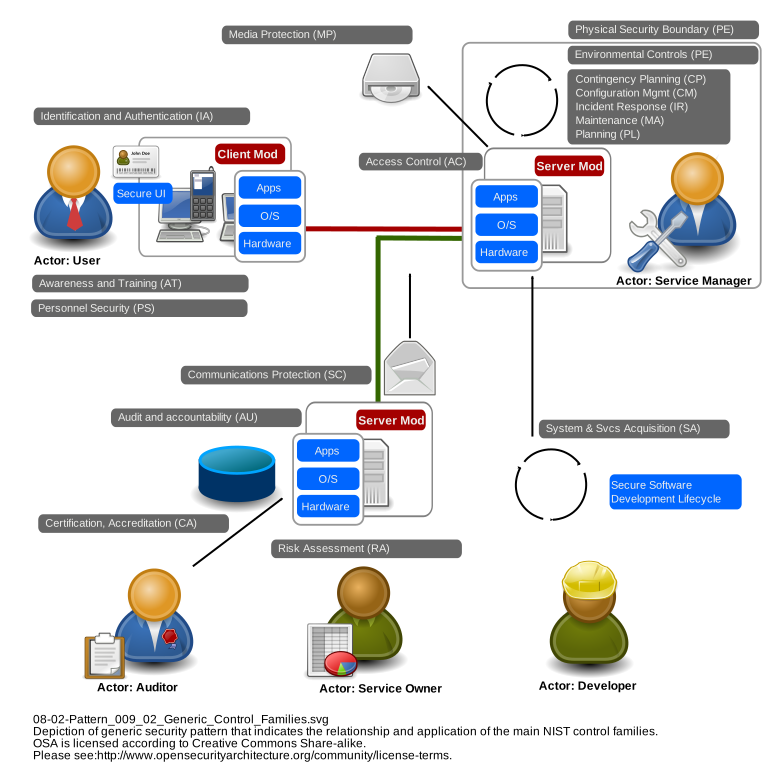
Key Control Areas
Access Control
Identification and Authentication
Audit and Accountability
System and Communications Protection
Configuration Management
Risk Assessment and Security Assessment
When to Use
Use the Generic Pattern as a starting point when designing security architecture for any new system or environment, before selecting more specific patterns. Valuable for training and education: it provides security architects with a mental model for where different control families apply in any computing architecture. Use it as a completeness validation tool after selecting specific patterns -- verify that all major control families have been addressed across client, network, and host tiers. Appropriate as a reference framework when conducting security architecture reviews or gap analyses. Useful for communicating security architecture concepts to non-specialist audiences who need to understand the relationship between controls and system components.
When NOT to Use
The Generic Pattern should not be used as a standalone security architecture for any real-world system. It does not provide the environment-specific control selection, implementation guidance, or threat context needed for an actionable security design. Do not use it as a substitute for risk-based control selection -- the pattern shows where controls apply, not which controls to implement or to what depth. Not appropriate as a compliance mapping tool on its own; use the specific patterns with their detailed control lists for compliance purposes. If you already know which specific OSA pattern applies to your environment, start there rather than with the Generic Pattern.
Typical Challenges
The primary challenge with the Generic Pattern is that its generality makes it insufficient on its own for any real-world implementation. Practitioners must move from the generic model to environment-specific patterns that provide actionable control guidance. The mapping of control families to architectural tiers can create a false sense of completeness if practitioners treat it as a checklist rather than a starting framework. Cross-cutting controls that span multiple tiers (incident response, contingency planning, security assessment) are harder to visualise in a tiered model and risk being under-addressed. The client-network-host model, while universal, does not naturally represent modern architectures such as serverless computing, container orchestration, or edge computing without interpretation. Organisations new to security architecture may find the gap between the generic model and actionable implementation guidance daunting without the more specific OSA patterns to bridge it.
Threat Resistance
As a foundational reference pattern, the Generic Pattern does not directly mitigate specific threats. Instead, it provides the architectural framework for understanding where threat mitigations apply. The client tier faces endpoint threats: malware, credential theft, physical access, and social engineering. The network tier faces interception, man-in-the-middle, denial of service, and lateral movement threats. The host tier faces application-layer attacks, privilege escalation, data breach, and configuration exploitation. By mapping control families to these architectural tiers, the Generic Pattern ensures that threat analysis is comprehensive across the full attack surface. Specific threat resistance is provided by the specialised patterns derived from this generic model.
Assumptions
All computing systems follow the fundamental client-network-host model, where users interact with client devices that communicate over networks to access resources on hosts. Hosts can act as both clients and servers in multi-tier architectures. The network layer is assumed to be untrusted and to simply transfer data packets -- security intelligence resides in the endpoints. The NIST 800-53 control framework provides a comprehensive and authoritative taxonomy of security controls applicable to this model. Specific control selection and implementation details are determined by the particular environment, risk profile, and regulatory context -- this generic pattern provides the structural mapping, not the implementation guidance.
Related Patterns
Patterns that operate within or alongside this one. Click any to view.