Secure Network Zone Module
Click any control badge to view its details. Download SVG
Key Control Areas
Zone Architecture and Trust Boundary Design
Firewall Rule Management and Policy Enforcement
Micro-Segmentation and Software-Defined Security
Network Access Control and Device Trust
Zone Monitoring and Anomaly Detection
Zone Classification and Data Flow Mapping
Cloud and Hybrid Zone Architecture
When to Use
This pattern applies to every organisation with more than a trivially small network. It is particularly critical for: organisations with regulatory segmentation requirements (PCI DSS requires network segmentation for scope reduction), financial services firms where regulators expect defence-in-depth network architecture, organisations running mixed-trust workloads on shared infrastructure (production and development, corporate and operational technology), organisations implementing Zero Trust Architecture (SP-029) where network segmentation is a foundational control, data centre environments with multiple applications and data classifications, hybrid cloud environments where consistent segmentation must span on-premises and cloud, and any organisation that has experienced lateral movement during a security incident.
When NOT to Use
Very small organisations (under 20 devices) may not need formal zone architecture -- a single flat network with endpoint protection and cloud-based security may suffice. Fully cloud-native organisations with no on-premises infrastructure may implement segmentation entirely through cloud-native controls (VPCs, security groups) without traditional firewall-based zone architecture. Organisations should not attempt micro-segmentation before achieving solid baseline segmentation (VLANs + firewalls) -- the fundamentals must work before adding complexity.
Typical Challenges
The greatest challenge is legacy flat networks: re-architecting a flat network into zones requires careful planning, phased implementation, and extensive application dependency mapping to avoid breaking connectivity. Application dependency discovery is harder than expected -- undocumented inter-system communications surface only when you block them. Firewall rule set complexity grows exponentially: a 10-zone model has 90 potential inter-zone paths, each requiring explicit rules. Rule bloat accumulates over years as rules are added but rarely removed, leading to rule sets with thousands of rules where nobody understands the full picture. Micro-segmentation requires significant investment: the tooling is expensive, the learning/profiling period is lengthy, and the initial policy generation requires validation with application owners who may not understand their own applications' network requirements. Cloud and on-premises zone architectures often evolve independently, creating inconsistent segmentation models that require different management tools and skills. Network performance concerns: every zone boundary adds latency and potential bottlenecks, particularly for latency-sensitive applications. Zone boundary bypass: developers and operations teams request 'temporary' broad rules that become permanent, gradually eroding the zone model.
Threat Resistance
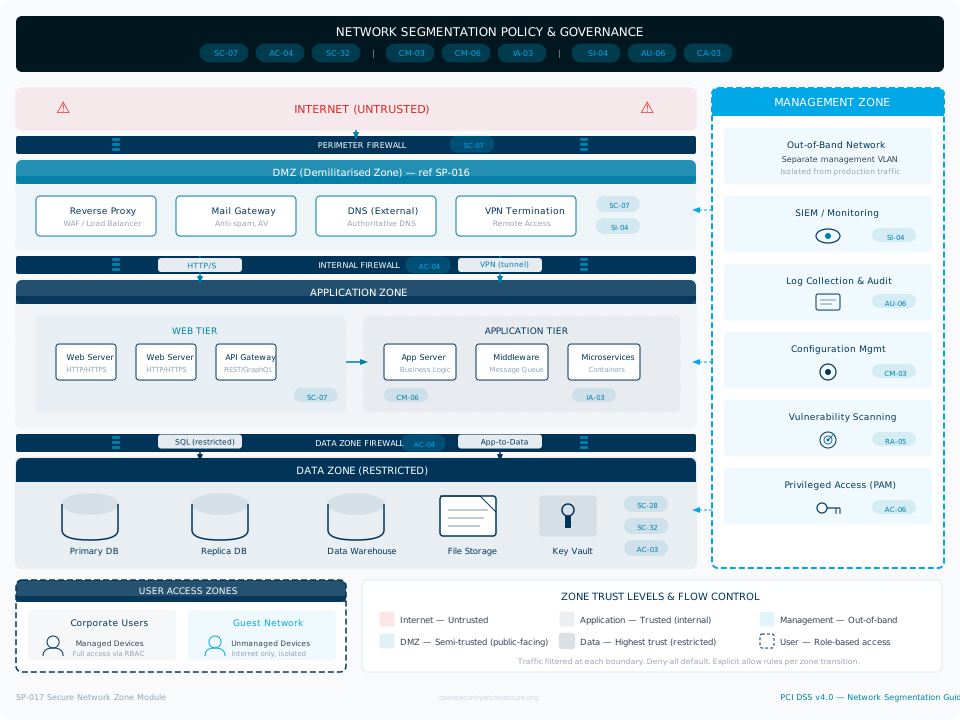
Network zone architecture is the primary control for containing lateral movement. An attacker who gains initial access to a user zone cannot reach the data zone or management zone without crossing a zone boundary that detects and blocks the attempt (SC-07, AC-04). East-west movement between servers in the same tier is constrained by micro-segmentation that limits communication to known-good patterns (SC-07, SI-04). Ransomware propagation is limited to the zone where initial execution occurs -- zone boundaries prevent the encryption spread that turns a single-system incident into an enterprise-wide event (SC-07, SC-32). Data exfiltration is constrained by zone egress controls: data zones have no direct internet access, so exfiltration requires traversing multiple zone boundaries, each of which provides a detection opportunity (AC-04, AU-02). Rogue device placement (physical or virtual) is detected by network access control that authenticates devices and enforces zone placement (IA-03, CM-08). Management plane compromise is contained by isolating management traffic in dedicated zones with the strictest access controls and monitoring (SC-07, SC-03). Cloud resource misconfiguration exposing data to the internet is detected by continuous monitoring of zone boundary configurations (CA-07, CM-02). The key insight: zone architecture does not prevent initial compromise, but it dramatically limits what an attacker can do after gaining access, buying time for detection and response.
Assumptions
The organisation has network infrastructure that supports segmentation (managed switches with VLAN capability, firewalls or security groups at zone boundaries). An IP addressing scheme exists or can be redesigned to align with zone architecture. Network operations staff have the skills to manage firewall rules and troubleshoot inter-zone connectivity. A change management process exists for network changes. Network monitoring tools (flow analysis, IDS/IPS) are deployed or budgeted for. The organisation has documented which systems process which data classifications.
Developing Areas
- Software-defined networking (SDN) is fundamentally changing how zone boundaries are created and managed, moving from hardware-defined VLAN and firewall configurations to policy-as-code abstractions. While this enables infrastructure-as-code approaches to zone architecture (Terraform-managed security groups, Kubernetes NetworkPolicy resources, NSX-T distributed firewall rules), it also introduces new risks: policy drift between code repositories and running configuration, misconfigured automation that can open zone boundaries at scale in seconds, and the need for security teams to review code rather than firewall GUIs. The operational model for SDN-based zone management is still being established.
- Network-as-code for zone policy management promises repeatability and audit trails but introduces a new class of operational risk. When zone boundaries are defined in Terraform modules or Ansible playbooks, a mismerged pull request can remove critical firewall rules across an entire environment. The security review process for infrastructure code changes requires network security expertise that many DevOps teams lack, and the tools for automated security validation of network-as-code (Batfish, Checkov network policies) are less mature than their application code counterparts.
- The granularity debate between coarse zone segmentation and fine-grained micro-segmentation is far from settled. Micro-segmentation vendors (Illumio, Guardicore/Akamai, VMware NSX) promise per-workload policies, but the operational reality is that generating, validating, and maintaining thousands of individual workload policies requires application dependency knowledge that most organisations do not have. The learning/profiling phase generates false positives that break production communication, and the ongoing maintenance as applications evolve creates a continuous operational burden that many organisations underestimate by a factor of 3-5x.
- Identity-based segmentation is emerging as an alternative to network-based zone architecture, where access decisions are based on authenticated workload and user identity rather than IP addresses and VLAN membership. Technologies like Google BeyondCorp, Azure Conditional Access with Entra Private Access, and SPIFFE-based service identity enable this model. However, identity-based segmentation requires mature identity infrastructure, consistent authentication across all workloads (including legacy systems), and a fundamentally different mental model for network security teams accustomed to thinking in terms of IP addresses and firewall rules. The transition from network-based to identity-based segmentation is a multi-year journey that most organisations have barely started.
- East-west traffic visibility remains the single largest blind spot in enterprise network security. Studies consistently show that 70-80% of network traffic is east-west (server-to-server within data centres), yet most monitoring and inspection capability is focused on north-south (client-to-server, internet-to-DMZ) traffic. Network flow analysis tools (NetFlow, sFlow) provide metadata-level visibility, but deep packet inspection of east-west traffic at data centre speeds requires hardware investment that few organisations have made. The rise of encrypted east-west traffic (mTLS in service meshes) further reduces visibility, creating a monitoring gap that attackers actively exploit for lateral movement.
Related Patterns
Patterns that operate within or alongside this one. Click any to view.
References
- NIST SP 800-53 Rev 5: Security and Privacy Controls
The control catalogue referenced throughout this pattern. System and Communications Protection (SC) and Access Control (AC) families are primary.
- NIST SP 800-125B: Secure Virtual Network Configuration for VM Protection
NIST guidance on virtual network segmentation. Covers virtual firewalls, network isolation, and security group configuration for virtualised environments.
- PCI DSS v4.0: Network Segmentation Guidance
PCI DSS network segmentation requirements and testing guidance. Demonstrates how zone architecture reduces compliance scope and protects cardholder data.
- CIS Controls v8: Control 12 - Network Infrastructure Management
CIS guidance on network security management including segmentation, firewall rules, and network access control.
- Gartner: Micro-Segmentation Market Guide
Market landscape for micro-segmentation solutions. Useful for vendor evaluation and understanding implementation approaches.
- SANS: Network Segmentation and Micro-Segmentation
SANS research on network segmentation strategies. Practical guidance on designing zone architectures and implementing micro-segmentation.
- NCSC: Network Security Principles
UK NCSC guidance on network security fundamentals including segmentation, monitoring, and access control.