Realtime Collaboration Pattern
Click any control badge to view its details. Download SVG
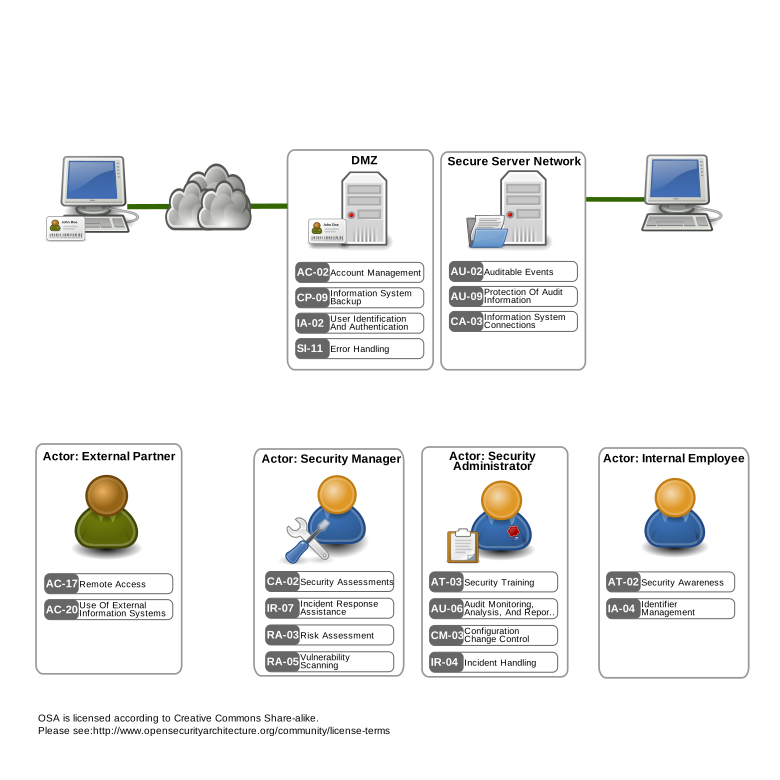
Key Control Areas
Account Management and Access Governance
Remote Access and External System Controls
Authentication and Identity Verification
Audit Trail and Monitoring
Configuration and Change Management
Vulnerability and Risk Management
Incident Handling and Security Awareness
When to Use
Use this pattern when internal and external partners must collaborate synchronously on shared documents, conduct video or voice conferences, share screens for presentations or demonstrations, or communicate via persistent chat channels. Applicable when the collaboration involves confidential or commercially sensitive information that requires encryption, access control, and audit trails. Appropriate for organisations adopting cloud-based collaboration suites (Microsoft 365, Google Workspace, Slack, Zoom) and needing a security architecture to govern their use. Also applicable when regulatory or contractual obligations require demonstrable controls over collaborative data sharing with external parties.
When NOT to Use
This pattern is not appropriate for ad-hoc, one-time file transfers where the Secure Ad-Hoc File Exchange pattern (SP-019) is more suitable. Not applicable where all collaboration is purely internal with no external participant requirement and the organisation already has adequate internal communication controls. The pattern assumes the ability to distribute authentication credentials or tokens to external participants; where this is not feasible (very large public audiences, anonymous participants), a different model such as webinar or broadcast architecture is more appropriate. Not suitable for air-gapped or highly classified environments where real-time collaboration with external parties is prohibited by policy.
Typical Challenges
The primary challenge is balancing security with the frictionless experience that drives adoption. Overly restrictive controls -- requiring hardware tokens for every external guest, blocking all file sharing, or disabling screen sharing -- push users to consumer alternatives (WhatsApp, personal Dropbox, unapproved Zoom accounts) that offer zero security visibility. Guest account lifecycle management is persistently difficult: collaboration spaces accumulate external participants over months or years, and without automated review and expiry, stale accounts with access to sensitive content proliferate. Data loss prevention is complicated by the real-time nature of the tools -- once a screen is shared or a document displayed in a meeting, the content has effectively been transmitted to all participants' endpoints regardless of download restrictions. Platform sprawl is another challenge: organisations often run multiple overlapping collaboration tools (Teams for internal, Zoom for external, Slack for development teams) creating inconsistent security policies and audit gaps. Regulatory compliance adds complexity when collaboration involves participants across jurisdictions with different data sovereignty requirements, and meeting recordings or chat logs become subject to retention and e-discovery obligations.
Threat Resistance
This pattern addresses data leakage through unmanaged external participant endpoints, which remains a residual risk that can be mitigated but not eliminated. It defends against unauthorised access to collaboration spaces through strong authentication, account lifecycle management, and session controls. The pattern mitigates man-in-the-middle attacks on collaboration streams through mandatory end-to-end or transport encryption. It addresses malicious file upload through content scanning of files shared in collaboration spaces. Unauthorised recording or screen capture is partially mitigated through platform controls and watermarking, though it cannot be fully prevented on unmanaged endpoints. The pattern defends against account takeover through MFA and anomalous access detection. It addresses the risk of shadow IT collaboration tools by providing a secure, usable sanctioned alternative. Compliance risks from uncontrolled data retention or missing audit trails are mitigated through logging, retention policies, and regular security assessments.
Assumptions
The organisation has selected or will select a collaboration platform that supports enterprise security controls including SSO, MFA, audit logging, and granular sharing policies. Shared information will include confidential business documents, and therefore both the communication channel and storage must be encrypted at rest and in transit. External participants will connect from endpoints that the organisation does not manage, and the architecture must account for this. Identity governance processes exist or will be established to manage the lifecycle of both internal and external collaboration accounts. Network bandwidth and reliability are sufficient to support real-time audio, video, and document collaboration without degradation that drives users to unmanaged alternatives.
Developing Areas
- End-to-end encryption in enterprise collaboration platforms is advancing but remains incomplete. Microsoft Teams enabled E2EE for 1:1 calls but not group calls or channels as of early 2026, and enabling E2EE disables features like recording, live captions, and compliance archiving that enterprises depend on. The fundamental tension between E2EE and enterprise requirements for DLP, eDiscovery, and compliance recording has no clean technical resolution, and platform vendors are navigating this trade-off differently with no industry consensus emerging.
- AI meeting assistants and copilots that join calls to take notes, summarise discussions, and generate action items create a significant and largely unaddressed data exposure risk. These tools process real-time audio and video streams through cloud-based AI models, potentially exposing confidential discussions to third-party providers. Guest participants may not be aware that an AI assistant is processing the meeting, raising consent and regulatory questions under GDPR and similar frameworks. Enterprise governance policies for AI meeting assistants are still forming.
- DLP for messaging platforms lags behind DLP for email and file sharing by several years. The real-time, informal nature of chat messages -- combined with rich media, reactions, threads, and integrations with bots and apps -- makes content classification and policy enforcement significantly harder than for structured email. Emerging approaches use ML-based content classification to detect sensitive data in chat streams, but false positive rates remain high enough to be disruptive in fast-moving collaborative conversations.
- Ephemeral messaging compliance is creating regulatory tension. Features like disappearing messages and auto-delete timers in platforms like Signal, WhatsApp, and even Teams are popular with users but may violate records retention requirements in regulated industries. Financial services regulators including the SEC and FCA have imposed significant fines for off-channel communications on ephemeral messaging platforms, yet prohibiting these tools entirely pushes usage further into shadow IT where it is completely invisible.
- Guest access governance across collaboration platforms is operationally immature at most organisations. The average enterprise accumulates thousands of external guest accounts across Teams, Slack, and other platforms, with no automated lifecycle management or cross-platform visibility. Emerging identity governance solutions are beginning to offer unified guest access reviews, but the lack of standardised federation protocols across competing platforms means that revoking a departing partner's access requires manual action on each platform separately.
Related Patterns
Patterns that operate within or alongside this one. Click any to view.
References
- NIST SP 800-46 Rev 2: Guide to Enterprise Telework, Remote Access, and BYOD Security
NIST guidance on securing remote access technologies including collaboration tools, VPN, and remote desktop. Covers policy, architecture, and endpoint security for telework scenarios.
- CISA Guidance on Securing Video Conferencing
CISA and FBI guidance on securing video teleconferencing against hijacking (Zoom-bombing), unauthorised access, and eavesdropping. Includes practical configuration recommendations.
- Microsoft: Security and Compliance in Microsoft Teams
Microsoft's overview of security and compliance in Teams: two-factor authentication and single sign-on, encryption, Conditional Access, sensitivity labels, data loss prevention and retention, and how Teams relies on SharePoint and Exchange.
- CIS Benchmark for Microsoft Teams
Center for Internet Security benchmark providing prescriptive security configuration guidance for Microsoft 365 including Teams, SharePoint, and Exchange Online.
- ENISA Secure Use of Online Collaboration Tools
European guidance on selecting and securely configuring online collaboration tools, with emphasis on data protection, encryption, and privacy considerations under GDPR.
- OWASP Testing Guide - Web Application Security
Relevant for browser-based collaboration platforms. Covers authentication testing, session management, input validation, and other web application security concerns applicable to collaboration tools.