Zero Trust Architecture
Click any control badge to view its details. Download SVG
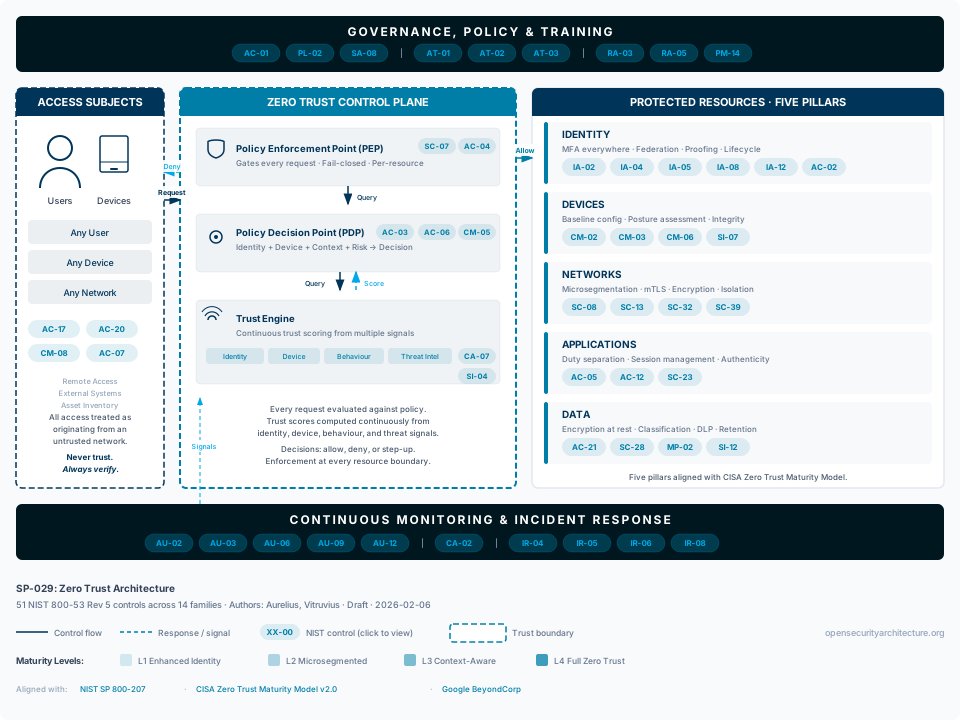
Key Control Areas
Identity Verification and Continuous Authentication
Access Control and Least Privilege Enforcement
Network Segmentation and Microsegmentation
Continuous Monitoring, Analytics, and Trust Scoring
Device Trust and Endpoint Posture
Data Protection and Classification
Policy Decision and Enforcement Architecture
Incident Response and Automated Containment
When to Use
This pattern applies to any enterprise that has moved beyond the assumption that internal networks are safe. It is particularly relevant for organisations with significant remote or hybrid workforces, cloud-first or multi-cloud strategies, high-value data requiring granular access control, regulatory requirements for continuous monitoring and least privilege, a history of lateral movement in security incidents, merger or acquisition activity creating heterogeneous network environments, or contractor and third-party access that extends beyond the traditional perimeter.
When NOT to Use
This pattern may be premature for organisations that lack basic security hygiene: if you do not have centralised identity management, asset inventory, or patch management, zero trust adds complexity without a foundation to build on. Air-gapped environments with strict physical access controls may derive limited benefit from the network-assumes-hostile model. Very small organisations (under 50 users) with simple network topologies may find the architectural overhead disproportionate to the risk reduction. Operational technology (OT) and industrial control systems often cannot support continuous authentication and may require purpose-built patterns (see SP-023).
Typical Challenges
Legacy applications that require network-level trust and cannot support modern authentication protocols are the primary blocker -- they require application proxies or gateway translation layers. The cultural shift from 'inside the firewall means trusted' to 'verify everything' faces resistance from users accustomed to frictionless internal access. VPN replacement is politically difficult when remote access 'just works' for users. Microsegmentation at scale generates enormous policy complexity -- without automation, rule sets become unmanageable. Device diversity (corporate, BYOD, contractor, IoT) makes uniform posture enforcement impractical; tiered access models add design complexity. Trust engine tuning requires balancing security (low trust thresholds) against usability (constant re-authentication prompts). Cost of deployment is front-loaded while benefits accrue gradually, making business case justification difficult. Multi-cloud and hybrid environments complicate consistent policy enforcement across trust boundaries.
Threat Resistance
Zero Trust Architecture addresses the full spectrum of post-perimeter threats. Lateral movement after initial compromise is contained by microsegmentation and per-resource authentication (SC-07, SC-32, AC-03). Credential theft and replay attacks are mitigated by continuous authentication, short-lived tokens, and phishing-resistant MFA (IA-02, IA-05, SC-08). Insider threats are detected through behavioural analytics and anomaly detection in the trust engine (SI-04, AU-06). Privilege escalation is prevented by dynamic least privilege and just-in-time access (AC-06, AC-02). Man-in-the-middle attacks on internal networks are eliminated by mandatory mTLS for all communications (SC-08). Compromised endpoints are contained by continuous posture assessment that revokes access when devices drift from baseline (CM-02, CM-06). Data exfiltration through trusted channels is prevented by information flow enforcement and DLP at policy enforcement points (AC-04, AC-21). Session hijacking is mitigated by continuous session validation and context-aware re-authentication (AC-12, IA-02). API abuse is controlled by per-request authorisation at the PEP layer (AC-03, AC-04). Trust boundary bypass attempts are detected by monitoring PDP/PEP integrity and policy consistency checks (CA-07, SI-07).
Assumptions
The organisation has consolidated identity providers to a manageable number (ideally one primary IdP with federation). Network infrastructure supports software-defined segmentation (not solely hardware-based ACLs). Endpoint management capability exists for corporate devices (MDM/UEM). Applications support modern authentication protocols (OAuth 2.0, OIDC, SAML). The organisation has defined data classification policies. Security operations capability exists to monitor and respond to trust engine signals. Executive sponsorship exists for the cultural shift from trusted-network to verify-everything.
Developing Areas
- Zero trust maturity measurement frameworks are still being standardised. CISA's Zero Trust Maturity Model (ZTMM) v2.0 provides the most widely referenced assessment framework, but organisations report difficulty mapping their hybrid architectures to CISA's five-pillar model, particularly when legacy systems span multiple maturity levels simultaneously. Competing frameworks from Forrester, Gartner, and vendor-specific models create confusion, and no industry-accepted certification or audit standard for zero trust exists -- organisations cannot yet demonstrate zero trust compliance to regulators or customers through a standardised assessment.
- Legacy system integration with zero trust architectures is the primary practical barrier to adoption. Applications that rely on network-level trust (IP-based access control, internal-only APIs without authentication, legacy protocols like SMB and RPC) cannot participate in identity-centric access decisions without intermediary proxies or gateway translation layers. Organisations with large estates of 15-20 year old applications face multi-year migration programmes, and the interim state -- partial zero trust with legacy exceptions -- creates architectural complexity and potential bypass paths that are difficult to secure.
- Zero trust for OT/ICS environments presents fundamental compatibility challenges. Industrial control systems often use protocols (Modbus, DNP3, OPC Classic) that do not support authentication or encryption, run on embedded systems that cannot execute modern identity verification, and have real-time latency requirements that continuous authentication may violate. Purpose-built approaches that apply zero trust principles at the zone boundary level while accepting traditional trust models within OT zones are emerging, but no consensus architecture exists for ZT-OT integration.
- Continuous authentication UX friction remains the most common user complaint in zero trust deployments. Step-up authentication prompts triggered by risk signals -- new device, unusual location, sensitive resource access -- interrupt workflow and generate help desk tickets. Organisations report that aggressive trust scoring leads to user workarounds (disabling VPN, using unmanaged devices) that undermine the security model. Adaptive authentication that balances security signals against user productivity without creating fatigue is an active area of platform development with no proven optimal approach.
- Policy engine interoperability across multi-vendor zero trust deployments is a significant gap. Most enterprises use identity providers, network segmentation, endpoint management, and cloud access security from different vendors, each with proprietary policy languages and enforcement mechanisms. The lack of a universal policy interchange format means that organisations cannot define a single zero trust policy and have it enforced consistently across their entire estate. Standards efforts including NIST's work on policy description languages are underway but years from broad adoption.
Related Patterns
Patterns that operate within or alongside this one. Click any to view.
References
- NIST SP 800-207: Zero Trust Architecture
The foundational reference for zero trust architecture. Defines core components (PDP, PEP, trust engine), deployment models, and migration approaches. Essential reading for any ZTA implementation.
- CISA Zero Trust Maturity Model v2.0
Provides a practical maturity model across five pillars (identity, devices, networks, applications, data) with progression levels from traditional to optimal. Useful for assessing current state and planning roadmap.
- NIST SP 800-53 Rev 5: Security and Privacy Controls
The control catalogue referenced throughout this pattern. Rev 5 adds privacy controls and aligns with zero trust principles.
- DoD Zero Trust Reference Architecture v2.0
Department of Defense zero trust reference architecture. Provides detailed component architecture and data flows for high-assurance environments.
- Google BeyondCorp: A New Approach to Enterprise Security
Google's seminal paper on eliminating the privileged corporate network. Describes the practical implementation that proved zero trust works at scale.
- NIST SP 1800-35: Implementing a Zero Trust Architecture
NIST National Cybersecurity Center of Excellence practice guide with reference implementations from multiple vendors.
- Forrester: Zero Trust eXtended (ZTX) Framework
Forrester originated the term 'Zero Trust' in 2010. The ZTX framework extends the model beyond network to include data, workloads, and automation.
- UK NCSC: Zero Trust Architecture Design Principles
The UK National Cyber Security Centre's practical guidance on zero trust design principles, with a focus on pragmatic adoption rather than vendor-driven approaches.