Passkey Authentication
Click any control badge to view its details. Download SVG
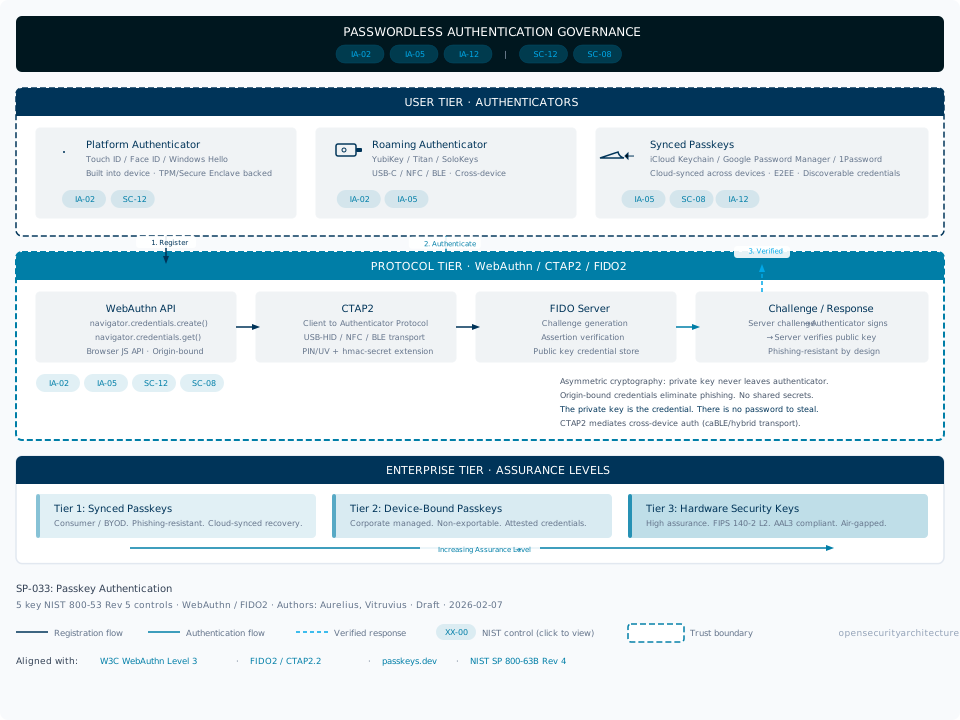
Key Control Areas
Authenticator Credential Management
Cryptographic Assurance and Key Protection
Registration and Ceremony Security
Authentication Ceremony and Phishing Resistance
Enterprise Policy and Tiered Access
Recovery and Fallback Mechanisms
Audit and Compliance
When to Use
This pattern is indicated for any organisation seeking to eliminate phishing as a viable attack vector against their users. It is particularly relevant for: financial services organisations facing sophisticated phishing campaigns, organisations subject to regulatory requirements for phishing-resistant MFA (US Executive Order 14028, PCI DSS v4.0 requirement 8.4.2), organisations with high-value accounts requiring strong authentication (administrators, executives, developers with production access), consumer-facing services wanting to improve authentication UX while strengthening security, and organisations already deploying FIDO2 hardware keys that want to extend passwordless authentication to the broader workforce via synced passkeys.
When NOT to Use
Organisations whose user base primarily uses devices that do not support WebAuthn (legacy browsers, very old operating systems) cannot deploy passkeys without first upgrading the device estate. Environments requiring authentication from shared or kiosk devices where biometric enrollment is impractical may need alternative approaches (though roaming authenticators work in this scenario). Organisations that require credential escrow or recovery through the IdP alone (without any user-side component) face challenges with the decentralised nature of passkey storage. If the threat model requires that no credential material ever leaves a certified hardware boundary, synced passkeys are inappropriate and only device-bound credentials (hardware keys, non-synced platform authenticators) should be used.
Typical Challenges
The biggest challenge is the transition period: organisations cannot simply switch off passwords overnight, so they run dual authentication paths (passwords and passkeys) for months or years, during which the password path remains the weakest link. Synced passkeys create a new dependency on platform vendors (Apple, Google, Microsoft) for key synchronisation security and availability. Enterprise use of synced passkeys means credentials may reside on personal devices, complicating offboarding -- credential revocation at the relying party is essential but does not remove the synced credential from the user's device. Hardware security key deployment at scale requires logistics: procurement, distribution, replacement for lost keys, and user training. Some legacy enterprise applications cannot integrate WebAuthn and require proxy-based solutions. Users with accessibility needs may struggle with biometric verification; PIN-based user verification must be available as an alternative. Cross-platform passkey synchronisation between Apple and Google ecosystems is improving but not seamless. Attestation verification is operationally complex: maintaining trust stores, consuming FIDO MDS updates, and handling authenticators that do not provide attestation.
Threat Resistance
Passkey Authentication provides the strongest available protection against credential-based attacks. Phishing attacks are cryptographically defeated: the authenticator binds the assertion to the relying party's origin, so credentials cannot be replayed on a different site even if the user is tricked into interacting with a phishing page (SC-23, IA-02). Credential stuffing and password spraying are eliminated: there are no passwords to stuff or spray (IA-05). Man-in-the-middle attacks are prevented: even if an attacker intercepts the authentication flow, they cannot forge the authenticator's signature (SC-13, SC-08). Credential theft from server breaches is neutralised: servers store only public keys, which are useless to attackers (SC-12). SIM swapping attacks that compromise SMS MFA are irrelevant: passkeys do not rely on phone numbers (IA-05). Push notification fatigue attacks (MFA bombing) are eliminated: passkeys require local user verification, not remote approval (IA-02). Credential cloning is detectable through signature counter validation for device-bound credentials and is prevented by secure element hardware for certified authenticators (SI-07). The remaining attack surface is primarily social engineering of the recovery process and compromise of the platform sync mechanism for synced passkeys.
Assumptions
Applications support the WebAuthn API (all major browsers have supported it since 2019). Users have devices with platform authenticators (Touch ID, Face ID, Windows Hello, Android biometrics) or the organisation provides hardware security keys. The Identity Provider supports FIDO2/WebAuthn as an authentication method. User devices are running sufficiently recent operating systems to support passkeys (iOS 16+, Android 9+, macOS Ventura+, Windows 10 build 1903+). The organisation has a credential management interface or can build one. A recovery process exists for users who lose all registered credentials.
Developing Areas
- Cross-platform passkey synchronisation security remains a significant trust question. Apple iCloud Keychain, Google Password Manager, and Microsoft Windows Hello each implement different sync encryption models, key escrow mechanisms, and recovery paths. No independent audit of these sync mechanisms has been published, and enterprises must trust platform vendor security claims without the ability to verify the cryptographic guarantees around synced credential material.
- Enterprise passkey provisioning at scale lacks mature tooling. Onboarding thousands of users to passkeys requires coordinated registration campaigns, helpdesk support for edge cases, and integration with identity governance platforms that were designed for password lifecycle management. Fewer than 10% of enterprise IdPs offer automated passkey enrollment workflows, forcing organisations into manual or semi-automated processes.
- Account recovery when all passkeys are lost is the unsolved hard problem of passwordless authentication. Current approaches -- recovery codes (revert to shared secrets), email-based recovery (downgrade to phishable factor), or in-person re-enrollment (does not scale) -- each undermine the security model in different ways. The FIDO Alliance is exploring social recovery and delegated recovery protocols, but no standardised solution has reached production maturity.
- Passkey adoption rates vary dramatically by sector. Consumer services with young, mobile-first user bases report 30-50% passkey registration rates within months of launch, while regulated enterprises in financial services and healthcare see single-digit adoption due to legacy device estates, accessibility requirements, and conservative change management. Bridging this gap requires sector-specific deployment strategies that current vendor guidance does not adequately address.
- The attestation trust model adds operational complexity that most organisations underestimate. Maintaining FIDO Metadata Service (MDS) trust stores, interpreting attestation certificates, and making policy decisions based on authenticator security properties requires cryptographic expertise that security teams typically lack. The distinction between basic, self, and attCA attestation types, combined with the growing diversity of authenticator models, creates a trust evaluation problem that has no simple tooling solution.
Related Patterns
Patterns that operate within or alongside this one. Click any to view.