Offensive Security Testing
Click any control badge to view its details. Download SVG
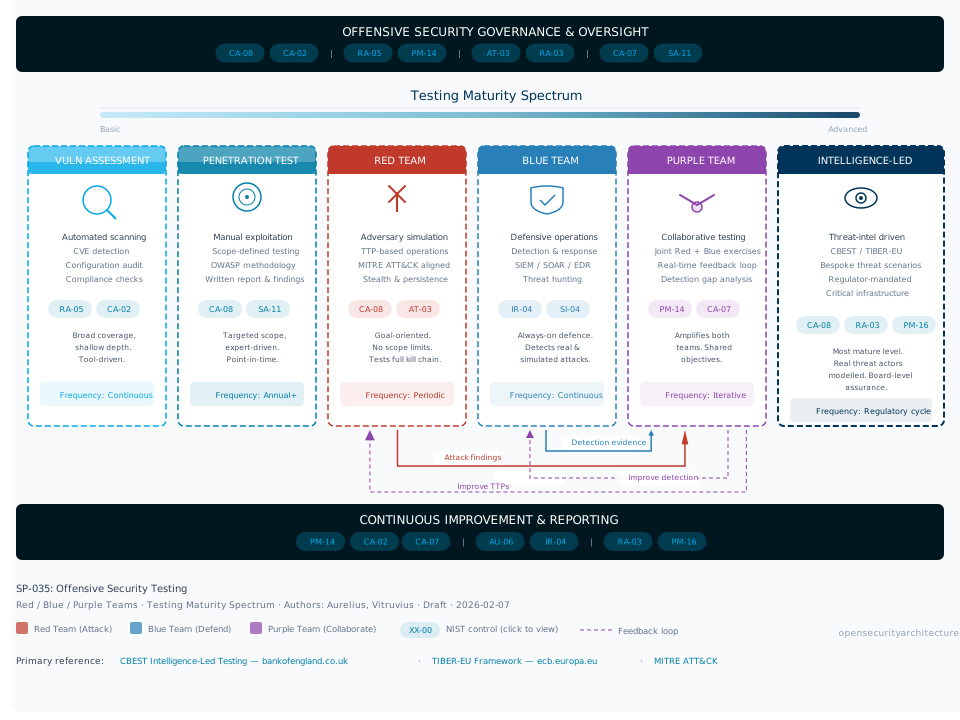
Key Control Areas
Penetration Testing and Vulnerability Assessment
Red Team Operations and Adversary Simulation
Purple Team Collaboration and Detection Validation
Intelligence-Led Testing
Remediation Management and Continuous Improvement
Automated Breach and Attack Simulation
Legal, Ethical, and Governance Framework
When to Use
This pattern is relevant for any organisation that wants evidence-based assurance of its security controls. It is essential for: financial services organisations subject to CBEST, TIBER-EU, or equivalent regulatory testing requirements, critical national infrastructure operators, organisations handling sensitive personal or financial data, entities that have suffered breaches and need to validate remediation effectiveness, organisations with mature security operations wanting to test and improve detection capability, and any organisation that relies on security compliance certifications and wants to validate that compliance translates to actual security.
When NOT to Use
Organisations without basic security controls in place (no patching, no access control, no monitoring) will get limited value from offensive testing -- the findings will be obvious and overwhelming. Fix the fundamentals first. Very small organisations with simple environments may find a standard vulnerability assessment and basic penetration test sufficient, without the overhead of red team or intelligence-led testing. Organisations without the capacity to remediate findings should not invest in expensive testing that produces reports which sit unactioned. If your SOC does not exist yet, testing it is pointless -- build it first (see SP-031), then test it.
Typical Challenges
Scope creep and scope gaps are mirror-image problems: testing too broadly increases risk and cost, while testing too narrowly creates a false sense of security. Rules of engagement that are too restrictive prevent realistic simulation, while rules that are too permissive create genuine risk to production systems. Red team findings can create political tension when they reveal that expensive security investments are not working as expected. The gap between finding vulnerabilities and fixing them is often measured in months, during which the organisation is knowingly exposed. Automated BAS tools require ongoing maintenance and tuning to avoid alert fatigue from simulated attacks. Intelligence-led testing is expensive (six-figure engagements) and resource-intensive, limiting frequency. Finding skilled red team operators is difficult; the talent market is extremely competitive. Testing cloud environments requires navigating cloud provider acceptable use policies and shared responsibility boundaries. Social engineering tests (phishing simulations) can damage employee trust if poorly communicated. Purple team exercises require mature relationships between red and blue teams; adversarial dynamics undermine collaboration.
Threat Resistance
Offensive Security Testing does not directly resist threats -- it validates that other controls do. Its value is meta-security: providing evidence-based assurance that the security architecture works as designed. By simulating real adversary techniques, it identifies gaps before real attackers exploit them. Specific validation includes: detection of initial access techniques (phishing, exploitation) validating controls from IA-02, SI-04, and AU-06. Detection of lateral movement validating SC-07, AC-04, and SI-04. Detection of privilege escalation validating AC-06, AU-02, and CM-06. Detection of data exfiltration validating AC-04, SI-04, and SC-07. Incident response effectiveness validating IR-04, IR-05, and IR-08. Recovery capability validating CP-09, CP-10, and CP-04. The ultimate measure of offensive testing effectiveness is reduced mean-time-to-detect and mean-time-to-respond in real incidents, and reduced blast radius when incidents occur.
Assumptions
Executive sponsorship exists for offensive testing including acceptance of controlled risk to live systems. The organisation has security operations capability (SOC) whose effectiveness can be tested. Budget is available for external testing providers (red team, threat intelligence, penetration testing). Legal authorisation for testing can be obtained from appropriate authority. The technology estate is sufficiently documented to define meaningful test scopes. Remediation capacity exists to address findings within reasonable timeframes. For intelligence-led testing: the organisation is of sufficient scale and criticality to warrant CBEST/TIBER-EU-level investment.
Developing Areas
- AI-assisted red teaming is fundamentally changing the economics of offensive testing. Large language models can generate phishing content, identify attack paths from configuration data, and automate reconnaissance at a pace that manual red teams cannot match. This simultaneously lowers the cost of testing and raises the bar for defenders, as adversaries gain access to the same AI-augmented capabilities. The methodology for incorporating AI into red team operations is still forming, with no established framework governing AI tool use during engagements.
- Continuous Automated Red Teaming (CART) aspires to replace periodic human-led engagements with always-on adversary simulation but remains immature. Current CART implementations are essentially enhanced BAS platforms with limited ability to chain techniques creatively or adapt to novel defences. The gap between scripted attack simulation and genuinely adaptive adversary behaviour means CART complements but cannot replace human red teams for at least the next 3-5 years.
- Purple teaming is transitioning from an occasional exercise to a standard operating practice, with dedicated purple team roles emerging in mature SOCs. The challenge is formalising the methodology: how to structure systematic coverage of MITRE ATT&CK techniques, how to measure detection improvement over successive exercises, and how to scale purple team practices across large organisations without creating a permanent dependency on expensive red team operators.
- Offensive testing for AI and ML systems is a nascent discipline with no established methodology. Testing AI models for prompt injection, training data extraction, model inversion, and adversarial manipulation requires skills that traditional penetration testers do not possess. OWASP has published initial guidance (OWASP ML Top 10, LLM Top 10), but the tooling and practitioner ecosystem for AI red teaming is at least 3 years behind traditional application security testing.
- Cloud-native attack simulation faces unique challenges around shared responsibility boundaries and provider acceptable use policies. Simulating lateral movement across AWS accounts, testing Kubernetes cluster escape, or exploiting cloud IAM misconfigurations requires careful coordination with cloud providers to avoid violating terms of service. The tooling for cloud-specific attack paths (Stratus Red Team, Pacu, GCPBucketBrute) is maturing but lacks the integration and automation of traditional infrastructure testing frameworks.
Related Patterns
Patterns that operate within or alongside this one. Click any to view.